



Frequently Asked Questions
Why use FSI - VTE branded battery terminal insulators?
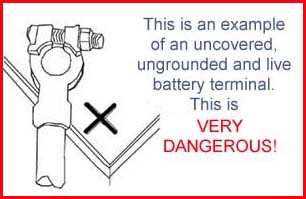 Uncovered, ungrounded and live battery terminals create an electrical hazard. According to CFR 183.420 (b) batteries must be installed so that metallic objects can’t come into contact with the ungrounded battery terminals. This is a law.
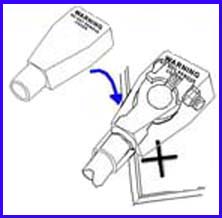 FSI offers a safe and inexpensive solution to keep your company in compliance with this law. When installed properly, our caps provide protection from electrical hazards.
Conductive vs. Fastening Nuts
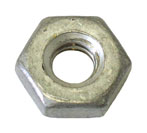 Conductive Fasteners (nuts)
Brass or plated brass nuts are used when a fastener is to be used in a conductive position. These conductive fasteners pass current more efficiently than steel. These nuts will be indicated by a ‘BLUE DOT’ marking, and should be kept in their conductive location.
Tightening Fasteners (nuts)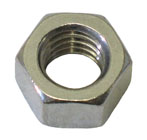
Stainless steel and steel nuts are used to torque or tighten an assembly. These fasteners are in a position where torque is necessary, but not conductivity. These fasteners are less expensive, thereby lowering the cost of the assembly, while increasing the amount of fastening torque allowed.
What are my material options?
| Material Type | Durometer (Shore “A”) | U.L. 94 Flame Class | Dialectric Strength in V/mil | Brittleness Temperature oC | Service Temperature oC | Tensile Strength PSI | Elongation % | Tear Strength Ppi |
|---|---|---|---|---|---|---|---|---|
| V – Vinyl (Standard Red) | 65 | V-2 | 511 | -48 | 105 | 1550 | 400 | 230 |
| V – Vinyl (Standard Black) | 65 | V-2 | 453 | -48 | 105 | 1550 | 400 | 230 |
| V – Vinyl (Standard Yellow) | 65 | V-2 | 514 | -48 | 105 | 1550 | 400 | 230 |
| V – Vinyl (Standard Grey) | 65 | V-2 | 495 | -48 | 105 | 1550 | 400 | 230 |
| V – Vinyl (Standard Hard Red) | 95 | V-2 | 438 | 1 | 105 | 2100 | 200 | 475 |
| V – Vinyl (Standard Hard Black) | 95 | V-2 | 384 | 1 | 105 | 2100 | 200 | 475 |
| V – Vinyl (Standard Hard Yellow) | 95 | V-2 | 428 | 1 | 105 | 2100 | 200 | 475 |
| F – Vinyl (FR Material Red) | 70 | V-0 | 553 | -30 | 105 | 1500 | 350 | 230 |
| F – Vinyl (FR Material Black) | 70 | V-0 | 500 | -30 | 105 | 1500 | 350 | 230 |
| T – Thermoplastic Vulcanizate (TPE Red) | 69 | HB | 680 | -60 | 135 | 1020 | 450 | 131 |
| T – Thermoplastic Vulcanizate (TPE Black) | 69 | HB | 680 | -60 | 135 | 1020 | 450 | 131 |
*S Material has been discontinued
* Due to difficulties in molding with T material, not all insulators are available in this material. Please contact VTE Inc. for functional usefulness and availability.
Define the term 'Barrel'
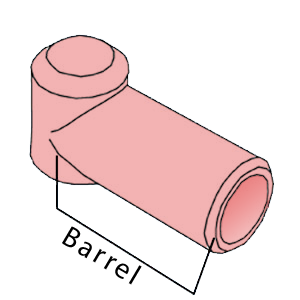 Barrel: part of the insulator cap designed to cover the terminal length of the entering cable or wire.
Where do I get the measurement for the cap's diameter?
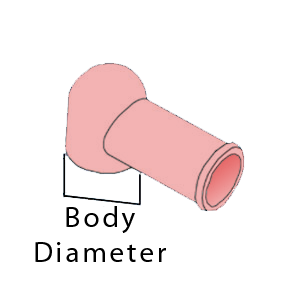 The diameter of the portion of the cap that fits over the terminal and post. The inside diameter of the cap’s body should match the outer diameter of the terminal and post.
What does the phrase 'Cable Entry Size' mean?
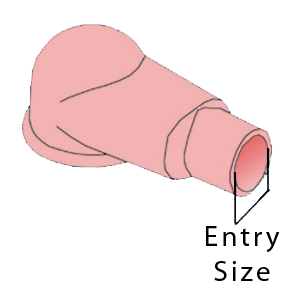 Cable Entry Size: Where the cable enters the cap. To size, use the inner diameter of the entrance of the cap’s barrel.
How to determine right or left side cable entry
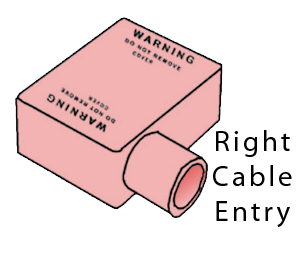
- Position insulator so terminal opening is facing down.
- Position insulator so cable entry is near you.
- Cable opening determines cable entry side.
What is a ring or eyelet terminal?
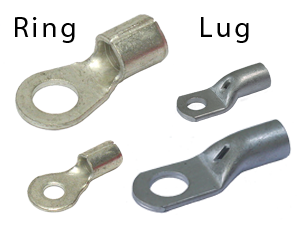
- Ring Terminals often are brazed, with open end.
- Lug terminals often are closed end, drawn from copper tube.
- Both ring and lug terminals are considered eyelet terminals.
What is the post height?
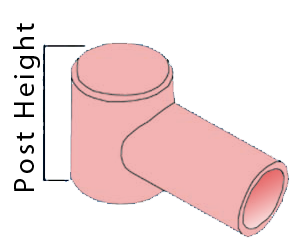 Post Height: the height of the stud / post / screw that must be covered. Use the body of the cap’s height for measurement.
How to find terminal length?
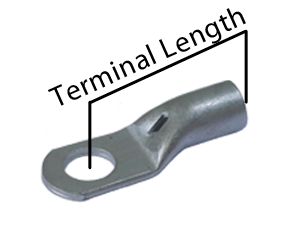 Find the terminal length by measuring from the center of the terminal ring and the end of the exposed metal. Use this measurement to determine the cap’s barrel length.
What is the term 'Terminal O.D.' refer to?
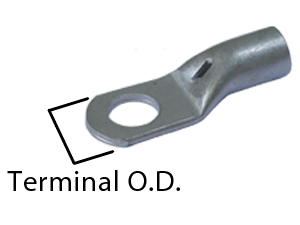 Terminal O.D. (outside diameter) refers to the width of the terminal or eyelet ring. Use this measurement to determine a cap’s body diameter.
Do VTE Insulators have a shelf life?
When stored in accordance with normal warehouse conditions, the shelf life of our molded components can exceed 10 years without failure.